Published: 06-24-2026, 12:27 pm
Key Takeaways
Gold’s four demand pillars — ETF investors, Chinese physical buyers, Indian bar-and-coin demand, and central banks — are rarely all moving in the same direction. Right now three of them have stepped back simultaneously, and one hasn’t.Central banks bought a net 244 tonnes in Q1 2026, above the five-year average, at near-record prices, extending seventeen consecutive months of net purchases without a meaningful response to price [WGC, Gold Demand Trends Q1 2026].A price floor set by sovereign reserve managers is structurally different from one set by momentum investors. It doesn’t break on a jobs report or a hawkish press conference — because the buyers aren’t there for the Fed cycle.
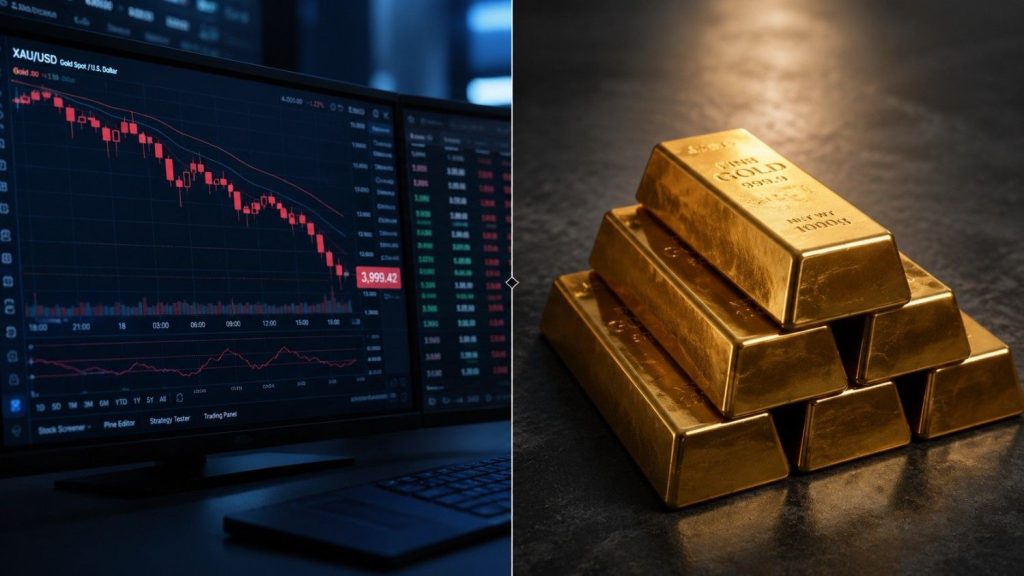
Gold hit $5,405 per ounce in January 2026. It is at $4,025 today [goldsilver.com/price-charts/, June 24, 2026]. That $1,380 correction has reshaped the gold price floor 2026 debate — and raised a more important question about where the gold price floor actually sits. The question is no longer how high gold goes. It is what is holding it up.
Deutsche Bank analyst Michael Hsueh published a research note on June 23, 2026, cutting the bank’s Q3 target by 22% — from roughly $5,500 to $4,300 [Deutsche Bank Research, June 23, 2026]. The note is being covered as a forecast cut. Read more carefully, however, it is something more useful. It is a systematic accounting of every buyer that has left the gold market. It also identifies the one buyer that hasn’t. Understanding the difference is the clearest way to assess what is actually supporting the gold price floor right now.
What Gold’s Demand Model Actually Looks Like
Gold demand is driven by four distinct buyer categories. Each has different motivations, different time horizons, and different sensitivity to monetary policy. Most coverage treats gold’s price as a single variable moving with the dollar or real yields. That framing is incomplete, however. Each pillar can exit independently of the others — and right now, three have.
Investor and Chinese Demand
Institutional and retail investors operate primarily through gold-backed ETFs and futures contracts. They are the most interest-rate-sensitive buyers in the market. When real yields rise and holding cash or bonds becomes more attractive, this group leaves. They came in hard from 2024 through early 2026. For example, North America alone added $51 billion in ETF inflows in 2025 — the strongest annual total on record [WGC, Gold ETF Flows December 2025]. They are now leaving.
Chinese physical demand reflects China’s status as the world’s largest gold consumer. Specifically, buyers operate through the Shanghai Gold Exchange and are less sensitive to Western rate cycles. When Chinese demand is strong, gold in Shanghai commands a premium over Comex prices. That premium signals that physical metal is moving east. It has recently compressed to a small discount [Deutsche Bank Research, June 23, 2026]. Consequently, Chinese imports are no longer providing the support they were.
Indian Demand and Central Banks
Indian bar and coin demand comes from the world’s second-largest gold market. In May 2026, the Indian government raised its basic customs duty on gold from 6% to 15% to defend the rupee [India Ministry of Finance, Notification No. 16/2026-Customs; CNBC, May 13, 2026]. That added roughly $700 per ounce to the landed cost of metal. As a result, the World Gold Council estimates this will suppress Indian jewellery and bar-and-coin demand by 50 to 60 tonnes in 2026 — a decline of about 10% year-on-year [WGC, India Gold Market Update, May 2026].
Central banks are sovereign reserve managers, primarily from emerging market economies diversifying away from the US dollar. They are the least price-sensitive buyers in the market. Still, they don’t trade quarterly earnings reports. They don’t have a redemption mechanism. When they decide gold is a core reserve asset, they keep buying through corrections.
In normal conditions, all four operate simultaneously. They layer demand and provide the metal with multiple floors. What the Deutsche Bank note documents, however, is an unusual condition. Specifically, three of the four have stepped back at the same time. As a result, only the fourth remains.
The Knowledge That Changes Everything
2 Free Guides
Two essential guides — yours free. Understand why gold matters and why fiat currencies always fail.
How Three Pillars Went Quiet
The proximate cause of the current pressure on the gold price floor is the Federal Reserve’s posture shift under Chair Kevin Warsh. His first FOMC meeting in June 2026 signaled a material hawkish turn. There was no resistance to market pricing for rate hikes. Moreover, the Taylor rule prescription was running roughly 80 basis points above current rates [Deutsche Bank Research, June 23, 2026]. Bank of America now forecasts three 25-basis-point hikes in the second half of 2026 [Bank of America Research, June 22, 2026]. Additionally, Deutsche Bank projects two [Deutsche Bank Research, June 23, 2026].
That shift repriced gold through the ETF channel almost immediately.
ETF and Futures Demand
By May 2026, global gold ETF outflows reached $2 billion. North America led the selling, ending a nine-month inflow streak that had made 2025 the strongest ETF year on record [WGC, Gold ETF Flows May 2026]. Total global ETF holdings ticked down to 4,121 tonnes. That is still near record highs in absolute terms, but the direction changed [WGC, Gold ETF Flows May 2026].
Futures markets told a similar story. COMEX open interest fell to what Deutsche Bank describes as a 17-year low [Deutsche Bank Research, June 23, 2026]. Net long positioning sits near its year-to-date lows. Traders who were long gold because the Fed was expected to cut have been unwinding. Rate cuts have receded from the calendar.
Global gold ETF holdings (monthly, left axis) vs. central bank net purchases (quarterly, right axis), tonnes. Sources: World Gold Council, Gold ETF Flows May 2026; World Gold Council, Gold Demand Trends Q1 2026.
Chinese and Indian Demand
Chinese demand has shifted from a tailwind to a neutral. Earlier in 2026, strong Chinese investment demand pushed the Shanghai premium — the markup buyers paid over Comex prices — to elevated levels. However, that premium has since compressed to a small discount. Deutsche Bank’s reading: Chinese imports will not be a meaningful support at current price levels [Deutsche Bank Research, June 23, 2026].
India is also a structural headwind. The customs duty hike makes India’s demand an on-and-off policy signal rather than a reliable gold price floor. The WGC notes that similar duty cycles in 2013 produced prolonged suppression. Before eventually recovering, demand remained depressed for several quarters. The near-term effect is clearly negative [WGC, India Gold Market Update, May 2026].
The Pillar That Didn’t Move
What makes the current gold price floor unusual is the one buyer category that has not responded to any of the above.
Central banks bought a net 244 tonnes of gold in Q1 2026 [WGC, Gold Demand Trends Q1 2026]. That is 3% above the prior year’s pace and above the five-year average. Prices were near all-time highs at the time. Seventeen consecutive months of net purchases have now run through some of the highest gold prices in history. There has been no meaningful demand response to price.
The National Bank of Poland led with 31 tonnes — part of a stated 700-tonne reserve target. Uzbekistan added 25 tonnes. Additionally, China’s People’s Bank of China added 7 tonnes, more than doubling its Q4 2025 pace [WGC, Gold Demand Trends Q1 2026: Central Banks]. The buyer list also expanded. It now includes central banks that had never historically bought in volume: Guatemala, Indonesia, Malaysia, Cambodia.
Indeed, Deutsche Bank’s Hsueh acknowledges this directly. “The one pillar which remains strong is central bank demand, and we expect this to be the case for some time to come” [Deutsche Bank Research, June 23, 2026]. He adds a qualification worth noting. Official demand has not accelerated as of Q1. It “will not compensate for otherwise slower investment demand on its own.” He is not calling central bank buying a rescue. He is, however, calling it a floor.
Why a Floor Set by Sovereign Buyers Is Structurally Different
A gold price floor held by central banks is not the same as a gold price floor held by momentum investors. That distinction matters — and it is the one that gets lost in forecast coverage.
When momentum investors set a floor, it exists until a catalyst moves them. A hot jobs report, a hawkish press conference, a change in rate expectations — any of these can break it. In other words, the floor is conditional.
Central bank buying operates differently. Emerging market reserve managers are not buying gold because they believe the Fed will cut in September. Instead, they are buying because they believe the current monetary architecture is structurally less reliable than it was a decade ago. That architecture includes US dollar dominance, dollar-denominated reserves, and Treasury bonds as the global safe asset. That belief does not change on a jobs report.
Furthermore, the mechanism is traceable to a specific event. When G7 sanctions froze Russia’s foreign exchange reserves in 2022, reserve managers received a vivid demonstration. Dollar-denominated reserves can be made inaccessible by political decision. Gold, however, cannot be frozen. It has no counterparty. Consequently, central bank accumulation since 2022 has been the direct institutional response to that lesson.
The data confirms the posture has not shifted. Specifically, the WGC’s 2025 Central Bank Gold Reserves Survey found that 95% of surveyed institutions expected global official gold reserves to increase over the next 12 months [WGC, Central Bank Gold Reserves Survey 2025]. That is the highest reading in the survey’s eight-year history. Moreover, a record 43% of respondents planned to increase their own holdings [WGC, Central Bank Gold Reserves Survey 2025: Perspectives on Gold Reserves]. Zero anticipated a reduction.
Those are not the signals of a buyer base that will exit on a Fed hike announcement.
What This Means for Gold at $4,025
Gold is currently trading below Deutsche Bank’s revised Q3 target of $4,300 [Deutsche Bank Research, June 23, 2026]. It is also well below the Q4 target of $4,800. The market has already corrected through the near-term forecast range, which tells you something about where the gold price floor currently sits. That is worth noting if you are assessing whether the worst of the repricing has been done.
Nevertheless, the more useful frame is not target arithmetic. It is understanding which demand pillar is currently doing the work.
Investor demand — ETFs, futures, leveraged positioning — responded quickly to the Fed’s hawkish shift and has repriced accordingly. Moreover, that demand will return when the rate picture improves, or when real yields compress from current levels. It is not gone. It has stepped back.
Central bank demand, however, has not moved. It is buying the same amount, at the new lower price, as it was buying at $5,000. From a purchasing-power standpoint, 244 tonnes at $4,000 buys those reserve managers more gold per dollar than 244 tonnes at $5,000 did [WGC, Gold Demand Trends Q1 2026].
For someone who owns physical gold for the same reasons central banks own it — as a monetary sovereignty asset rather than a rate-cut trade — the current environment is the thesis in its clearest form. The traders left. The sovereigns stayed. The gold price floor held. It held because the buyers setting it are not here for the rate cycle.
Overall, that is not a prediction. It is a description of the mechanism that Deutsche Bank’s own note, stripped of its headline number, is actually documenting.
Stay On Top of Gold & Silver Prices
Get important market alerts sent straight to your inbox.
People Also Ask
What is the gold price floor in 2026?
Deutsche Bank’s base case places a soft floor in the $4,300–$4,800 range for H2 2026, contingent on the Fed holding rates steady. Their bear case — three to four Fed hikes — puts the floor at $3,800. The structural floor, independent of Fed policy, is set by central bank demand running at approximately 244 tonnes per quarter [Deutsche Bank Research, June 23, 2026; WGC, Gold Demand Trends Q1 2026].
Why is gold falling in 2026?
The primary driver is a hawkish repricing of Federal Reserve policy under Chair Kevin Warsh, whose first FOMC meeting signaled growing support for rate hikes. Higher expected real yields increase the opportunity cost of holding non-yielding gold, triggering ETF outflows and futures unwinding. Deutsche Bank identifies Fed repricing, combined with resilient US economic data, as the dominant force behind the decline from January’s peak of $5,405 [Deutsche Bank Research, June 23, 2026].
Are central banks still buying gold in 2026?
Yes. Central banks bought a net 244 tonnes in Q1 2026, up 3% year-over-year and above the five-year average, extending seventeen consecutive months of net purchases. Major buyers include Poland (31 tonnes), Uzbekistan (25 tonnes), and China’s PBoC (7 tonnes). The WGC’s 2025 survey found 95% of central banks expect global official gold reserves to increase over the next 12 months [WGC, Gold Demand Trends Q1 2026; WGC, Central Bank Gold Reserves Survey 2025].
What happens to gold if the Fed raises rates?
Rate hikes raise real yields and increase the opportunity cost of holding non-yielding gold, typically triggering ETF outflows and reduced futures positioning. Deutsche Bank warns three to four Fed hikes in 2026 could push gold to $3,800. Central bank demand is historically insensitive to rate cycles — sovereign buyers accumulate gold for reserve diversification, not yield, and are unlikely to reverse course in a hiking environment [Deutsche Bank Research, June 23, 2026].
Why do central banks buy gold?
Central banks buy gold to diversify reserves away from dollar-denominated assets and hold a reserve that carries no counterparty risk. Since G7 sanctions froze Russia’s foreign exchange reserves in 2022, emerging market central banks have accelerated purchases: gold cannot be frozen by a foreign government’s political decision. The WGC’s 2025 survey found zero central banks anticipated reducing gold holdings [WGC, Central Bank Gold Reserves Survey 2025].
SOURCES1. World Gold Council — Goldhub Research & Data2. CNBC — India Hikes Bullion Import Duties, May 13, 20263. GoldSilver — Live Gold & Silver Spot Prices
Disclaimer: This article is for informational purposes only and does not constitute financial or investment advice. Always consult a qualified financial adviser before making investment decisions.
You May Also like:
Source link