


Published: 06-10-2026, 12:58 pm
Key Takeaways
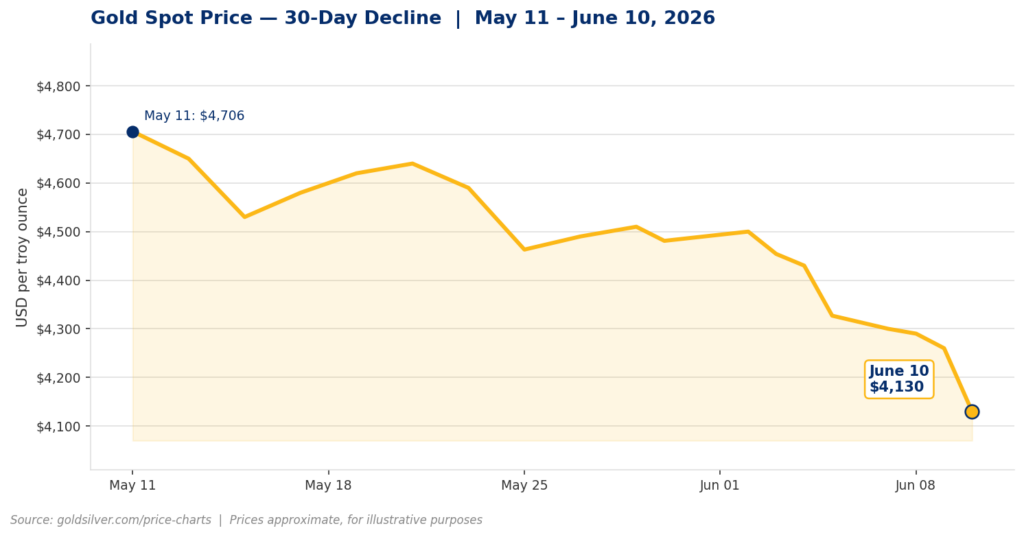
Gold fell to $4,130 today — its lowest since late November 2025 — after hot CPI data and fresh US-Iran strikes.May Consumer Price Index came in at 4.2% year-over-year, the highest since April 2023, with energy driving more than 60% of the monthly gain.The Iran war is counterintuitively bearish for gold: the oil shock feeds inflation, which feeds Fed rate-hike expectations, which raises the cost of holding gold.Core CPI — which strips out food and energy — came in at 2.9% annually. Underlying inflation is not yet spiraling.When the Strait of Hormuz reopens, the mechanism reverses: oil falls, CPI cools, rate-hike pressure fades, and gold recovers.
Notably, Trump posted something on Truth Social this morning that most financial reporters will treat as noise. Yet it is the key to understanding why gold is falling.
“Iran’s Military is a complete and total mess,” he wrote. “Much of it, like their Navy and Air Force, doesn’t even exist anymore — They have been completely defeated.”
Gold is at $4,130 per ounce. Down $130. Down 3%. Its lowest since late November 2025.
May inflation came in at 4.2% year-over-year — the hottest since April 2023. War is escalating. And gold fell. Here’s exactly why.
The Edge Every Investor Needs Smarter precious metals investing starts here. The Nuggets Newsletter brings you essential market insights, Fed updates, global trends, educational videos, and much more.
Why Is Gold Falling During a War?
Most investors carry a simple intuition: war equals gold up. That logic isn’t wrong. It just has a stronger competitor right now.
This war, however, is different. Because this conflict closes off 20% of global oil supply, it doesn’t just create geopolitical risk — it creates inflation. And inflation creates the one thing gold cannot afford: the expectation of higher interest rates.
Here is the four-link chain driving today’s move:
1. The Strait of Hormuz is effectively closed. It has been since the US-Iran war began on February 28, 2026. The waterway handles roughly one in five barrels of oil traded globally, per the International Energy Agency. It is 21 nautical miles wide at its narrowest point. As a result, closing it drives energy prices up.
2. Energy prices are driving inflation. The Bureau of Labor Statistics confirmed it this morning: May CPI rose 4.2% year-over-year. Energy drove more than 60% of the monthly increase. Gasoline alone surged 7%.
3. Hot inflation forces the Fed toward rate hikes. Markets now price a 70% chance of a December hike, per the CME FedWatch tool. Goldman Sachs scrapped all 2026 rate cuts this week, per Bloomberg. The bank’s first expected cut is now June 2027.
4. Higher rates make gold expensive to hold. Gold pays no interest. A Treasury bond at 4.5% does. When rate expectations rise, investors who owned gold as a rate-cut hedge rotate out. That’s what’s happening today.
This morning, US forces struck Iranian air defense sites near the Strait. In response, Iran claimed a retaliatory drone attack on the US 5th Fleet in Bahrain, per US Central Command. The diplomatic track is broken. Consequently, the Strait stays closed, and so does the pressure on gold.
Does Core CPI Tell a Different Story?
The headline CPI figure — 4.2% — is not what moved gold this morning.
Instead, the figure that matters is core CPI: up 0.2% month over month, 2.9% year over year. Core strips out food and energy. It measures whether war-driven price pressures are bleeding into rent, services, and wages. At 0.2% monthly, they are not — yet.
This distinction is crucial for long-term investors. Specifically, energy inflation is external and event-driven. Core inflation, by contrast, is structural. Right now, the problem is concentrated, not entrenched.
That changes the moment Hormuz reopens. When oil prices fall, energy’s CPI contribution collapses. The Fed’s rate-hike justification weakens. Gold’s suppressor lifts.
What Happens to Gold When Hormuz Reopens?
Gold is down 26% from its all-time high of $5,589.38, set January 28, 2026. That drawdown matches the 2022 Fed hiking cycle. Back then, the Fed raised rates by 500 basis points — one basis point equals one-hundredth of a percent — over 16 months, per the Richmond Federal Reserve.
The difference, however, matters enormously. In 2022, those hikes were real and delivered. Today, markets are pricing a 70% probability of a single 25-basis-point increase that hasn’t happened yet. The same percentage decline. A fundamentally different cause.
When Hormuz reopens, the chain runs in reverse. Oil falls, CPI cools, hike bets unwind, real yields — the interest rate minus inflation, gold’s most reliable price driver — compress. Gold reprices upward.
Importantly, the structural floor has not moved. China has bought gold for 18 consecutive months through April 2026, per the World Gold Council. US national debt also exceeds $36 trillion. Furthermore, fiscal deficits are running near 6% of GDP. These forces do not respond to a single CPI print.
Kevin Warsh chairs his first FOMC — the Fed’s rate-setting body — meeting on June 16–17. The dot plot maps each member’s interest rate forecast. It will signal how much longer this pressure lasts.
Ultimately, today’s selloff is not an argument against gold. This is the thesis in motion — energy-driven inflation creating short-term noise while the monetary case builds underneath.
Stay On Top of Gold & Silver Prices
Get important market alerts sent straight to your inbox.
SOURCES1. GoldSilver — Gold Price Charts2. US Bureau of Labor Statistics — Consumer Price Index, May 20263. CME Group — FedWatch Tool4. US Central Command — U.S. Completes Strikes in Response to Iran’s Attack on Apache5. CNBC — Oil Price: US Completes Iran Strikes After Apache Helicopter Attack6. Washington Post — U.S. Strikes Iran After Helicopter Downed Near Strait of Hormuz7. Bloomberg — Goldman Sachs No Longer Expects Fed Rate Cut This Year8. World Gold Council — Central Banks Resume Net Buying in April9. International Energy Agency — Strait of Hormuz10. Richmond Federal Reserve — A Rate Cycle Unlike Any Other11. Federal Reserve — Kevin Warsh Takes Oath of Office as Chairman
Disclaimer: This article is for informational purposes only and does not constitute financial or investment advice. Always consult a qualified financial adviser before making investment decisions.
You May Also Like:
Source link


