Published: 07-13-2026, 02:19 pm | Updated: 07-13-2026, 02:46 pm
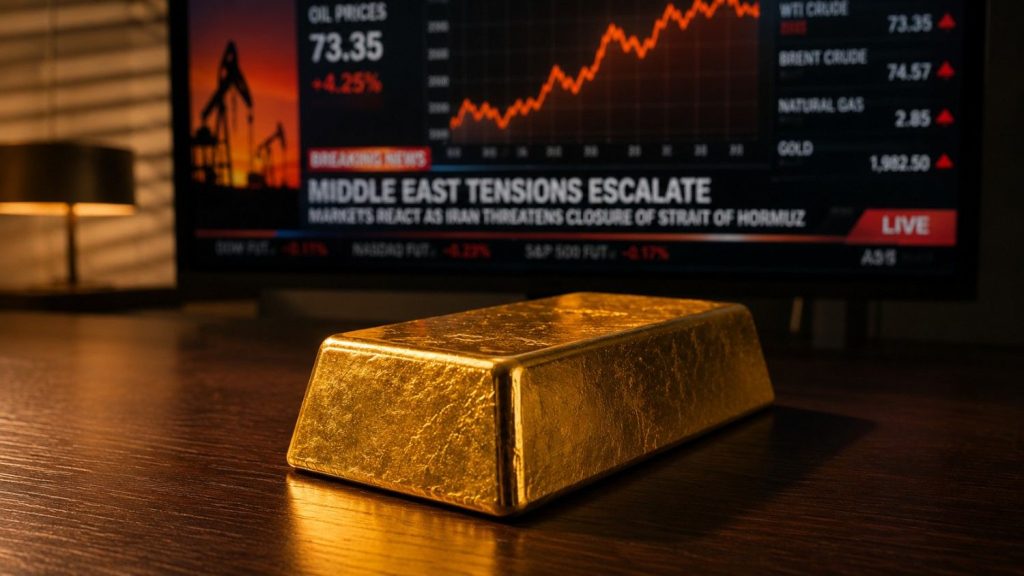
This morning, President Trump posted to Truth Social declaring that the United States would become the “GUARDIAN OF THE HORMUZ STRAIT.” Every cargo ship transiting the passage would pay a 20% levy for the privilege. Gold had already fallen sharply on Iran airstrikes earlier in the session, but it dropped another $40 in twenty minutes on the news. By early afternoon, it had dipped as low as $4,005. [Source: Bloomberg, July 13, 2026]
That reaction looks backwards at first glance. A war, a shipping toll, and an oil price surge: these sound like exactly the conditions that drive investors to gold. So why did gold fall?
Why Did Gold Fall When Oil Prices Surged?
The answer runs through a four-step chain — and understanding each step is more useful than watching any single price move.
When Trump announced the Hormuz toll, Brent crude jumped to about $79.75 a barrel, roughly 13.6% above pre-war levels. [Source: Investing.com, July 13, 2026] That is not just an energy story. Roughly 20% of the world’s seaborne oil supply transits the Strait of Hormuz, along with about 20% of global liquefied natural gas. [Source: IEA] When that passage becomes a toll road with a 20% surcharge on top of war-risk insurance and rerouting costs, energy prices do not stay elevated for a week. They get embedded in the structure of everything that ships, everything that runs on power, and everything made from petroleum feedstocks.
So: higher embedded energy costs produce higher sustained inflation. Sustained inflation means the Federal Reserve has to consider another rate hike. And when markets price in a higher probability of Fed tightening, bond yields rise. Gold — a metal that pays no interest — cannot compete with a Treasury bond paying 4.58% on the 10-year. [Source: Investing.com, July 13, 2026] Therefore, investors sell gold to buy bonds. The price falls.
The bond market had already priced in a near 60% probability of a September rate hike before today’s session opened. [Source: CME FedWatch Tool via FXEmpire, July 12, 2026] Today’s oil move pushed that probability higher still. By Monday afternoon, markets were pricing in a nearly 70% chance of a September hike. [Source: TradingEconomics, July 13, 2026] Nicky Shiels, Head of Research and Metals Strategy at MKS PAMP, noted that oil’s gains were shifting market attention squarely toward Tuesday’s CPI reading. [Source: Investing.com, July 13, 2026]
June CPI lands tomorrow morning at 8:30 AM Eastern. Fed Chair Kevin Warsh testifies before the House Financial Services Committee ninety minutes later. Together, those two events will tell the bond market whether the September hike is a near-certainty or merely a possibility — and gold will follow that signal either way.
The Edge Every Investor Needs Smarter precious metals investing starts here. The Nuggets Newsletter brings you essential market insights, Fed updates, global trends, educational videos, and much more.
What Does Trump’s Hormuz Toll Mean for Gold Prices Long Term?
Here is where the short-term trade and the long-term thesis diverge sharply.
The same inflationary pressure pushing gold lower today is precisely the argument for owning gold over the next three to five years. Every dollar the Hormuz disruption adds to the structural cost of global shipping is a dollar of purchasing power that savers cannot recover through a bank account or a government bond. The 20% toll is not a temporary surcharge. It is a new cost layer embedded in global supply chains. Shipping operators will price it in. Manufacturers will pass it on. Consumers will feel it in the grocery store and at the pump.
This is not a prediction about what gold does next month. Instead, it is a description of the mechanism the monetary debasement thesis has always pointed to: when governments and their conflicts impose costs on the real economy that central banks cannot fix with interest rates, the purchasing power of currency-denominated savings erodes. Gold’s job is to be outside that system.
Is the Structural Case for Gold Still Intact?
Yes — and the central bank data shows it clearly.
The People’s Bank of China added 14.93 tonnes of gold to its reserves in June 2026. That was its largest single-month purchase since 2023, extending its buying streak to twenty consecutive months. [Source: China State Administration of Foreign Exchange, July 7, 2026] That purchase happened during gold’s worst quarterly decline since the 2013 taper tantrum. Central banks do not trade on headlines. They allocate against a thirty-year purchasing power horizon.
Gold is currently about 28% below its January 28, 2026 all-time high of $5,589.38. [Source: goldsilver.com/price-charts/] The mechanism that created that high — monetary expansion, fiscal deficits running above sustainable levels, and structural de-dollarization — has not reversed. Trump’s Hormuz toll accelerates it.
Watch tomorrow’s CPI number closely. If June inflation holds above 4.0%, September hike odds push toward 65% and short-term gold pressure continues. If it prints below 3.8%, that same four-step chain runs in reverse: hike probability falls, real yields ease, and gold recovers ground. Warsh’s tone before Congress will tell you which way the bond market is leaning — before it leans there.
The short-term mechanism is clear. The long-term mechanism is clearer.
Stay On Top of Gold & Silver Prices
Get important market alerts sent straight to your inbox.
Disclaimer: This article is for informational purposes only and does not constitute financial or investment advice. Always consult a qualified financial adviser before making investment decisions.
You May Also Like:
Source link