Published: 07-02-2026, 02:26 pm
The unemployment rate dropped to 4.2% in June. It fell only because the labor force participation rate sank to 61.5%, the lowest since March 2021. In short, fewer people looking for work, not more people finding jobs, drove the improvement. So that’s the gold price unemployment rate mechanism markets priced in on July 2, 2026, before most headlines caught up.
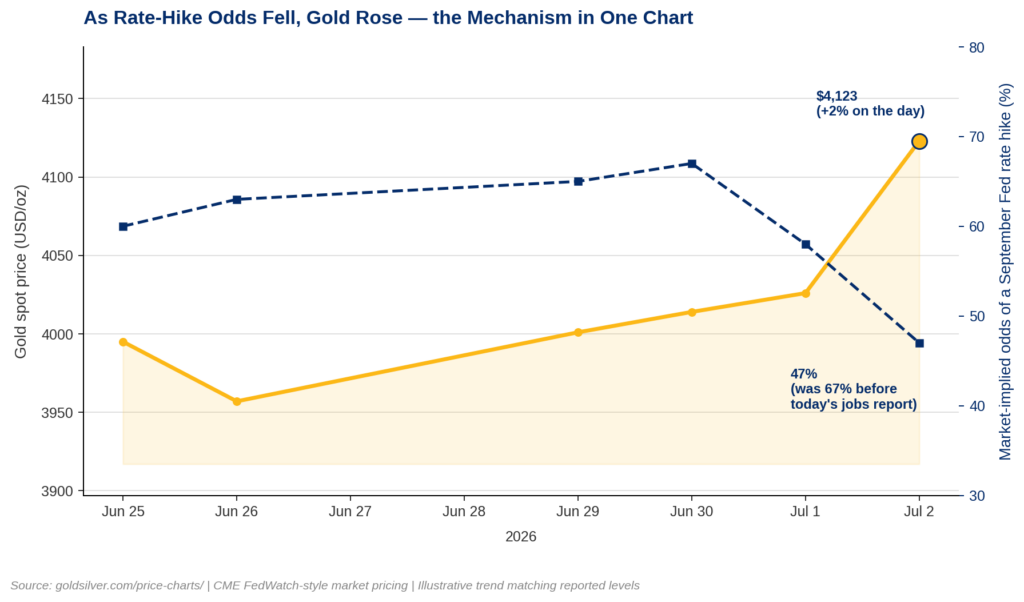
Gold broke above $4,100 an ounce on July 2, 2026, trading as high as the $4,140s during the morning session. That’s up roughly 2% on the day (see the live gold price at goldsilver.com/price-charts/). Meanwhile, silver is trading above $61, up more than 3%. Both moves extend the reversal GoldSilver flagged earlier in its July 2, 2026 coverage. That piece covered the setup. Specifically, a hawkish repricing was unwinding on a soft ADP print and dovish comments from Fed Chair Kevin Warsh. But the June jobs report itself hadn’t landed yet. Still, it has now, and it did more damage to the hawkish case than the ADP miss.
What the Jobs Report Showed
The Bureau of Labor Statistics reported that U.S. employers added just 57,000 jobs in June. In fact, that badly missed the roughly 115,000 economists surveyed by Dow Jones expected. It’s the weakest print in four months. Also, April and May payrolls were revised down by a combined 74,000 jobs. Leisure and hospitality lost 61,000 jobs in June, despite hopes that World Cup-related hiring would provide a boost. In addition, average hourly earnings rose 3.5% year over year, keeping wage growth roughly where it’s been.
The Edge Every Investor Needs Smarter precious metals investing starts here. The Nuggets Newsletter brings you essential market insights, Fed updates, global trends, educational videos, and much more.
The Gold Price Unemployment Rate Link
The labor force participation rate is the mechanism connecting the gold price and the unemployment rate this week. Call it the gold price unemployment rate link: it fell from 61.8% in May to 61.5% in June. Indeed, the household survey showed 507,000 fewer people employed month over month, per BLS data. People didn’t find jobs. Instead, they stopped being counted as looking for one. An unemployment rate that falls because the labor force shrinks is a weaker number dressed up as a stronger one. Still, headlines will call it stability. But the underlying data says something closer to fatigue.
Why Gold and Silver Moved
That mechanism, not sentiment, is what moved gold and silver. It’s the same gold price unemployment rate dynamic driving both metals. In fact, CME FedWatch data tell the real story. Odds of a September rate hike slid from 67% before the report to under 50% after it. At the same time, the policy-sensitive 2-year Treasury yield fell to 4.13%. In turn, lower rate-hike odds mean lower expected real yields. Real yields are the direct opportunity cost of holding gold, which pays no interest. When the market takes hikes off the table, it changes the calculus. So there’s less reason to prefer a Treasury bill over an ounce of metal.
Seema Shah, chief global strategist at Principal Asset Management, addressed the report on July 2, 2026. Simply put, she said the slowdown challenges the narrative of a re-strengthening labor market. More importantly, she said, it tells the Fed it doesn’t need to tighten policy further. That’s the read gold is trading on. Not “the economy is struggling.” Just this: the central bank has one less reason to favor cash over metal.
The Sound Money Angle
This is the trap the Fed keeps landing in. Notably, core PCE inflation sits at 3.4% year over year as of May 2026. That’s per the Bureau of Economic Analysis, the Fed’s preferred inflation gauge, and it’s well above the 2% target. So the data argues for staying tight. Meanwhile, a cooling labor market argues against tightening further. Some of that cooling traces to the labor force participation rate, not real job losses. Every month the Fed sits in that trap, real yields stay compressed. As a result, compressed real yields are the single biggest tailwind gold has. Gold doesn’t need the Fed to cut. It just needs the Fed to stay stuck.
The Second Corner
The deeper story isn’t the 57,000 print or the 4.2% headline. It’s this: a falling unemployment rate usually reads as reassuring. This one is quietly built on a falling participation rate, not stronger hiring. Yet gold priced that distinction correctly within hours. Most of the day’s commentary treated the number at face value instead. That’s the gold price unemployment rate gap most headlines missed. In short, that gap between the optics and the mechanism is where the sound money case lives. Clearly, official statistics can look better than the reality they’re supposed to measure. That’s exactly why a saver who wants an honest store of value learns to read past the headline print.
What to Watch Next
Watch two dates from here. First, the June CPI report lands July 14, 2026. A hot core print could revive the unwound hike bets. Second, the next FOMC meeting runs July 28 to 29, 2026. So the July 2 jobs data makes a hold there look close to certain. Also worth tracking: the gold-silver ratio, per goldsilver.com/price-charts/. Interestingly, it has compressed toward the high 60s as silver’s gain again outran gold’s on July 2, 2026. That’s a pattern GoldSilver has now covered two days running. In other words, the gold price unemployment rate story isn’t over yet.
Stay On Top of Gold & Silver Prices
Get important market alerts sent straight to your inbox.
SOURCES1. Bureau of Labor Statistics — The Employment Situation, June 20262. CNBC — U.S. job creation cools in June with payrolls growth of just 57,000; unemployment rate at 4.2%3. FXStreet — Nonfarm Payrolls rise by 57K in June vs. 110K expected4. TD Economics — U.S. Employment (June 2026)5. Trading Economics — Gold, Silver spot price data6. CNBC — Core inflation rate hit 3.4% in May, Fed’s preferred gauge shows7. GoldSilver — Live Gold & Silver Price Charts
Disclaimer: This article is for informational purposes only and does not constitute financial or investment advice. Always consult a qualified financial adviser before making investment decisions.
You May Also Like:
Source link