Published: 05-22-2026, 11:28 am | Updated: 05-22-2026, 11:35 am
Key takeaways:
Silver industrial demand accounts for ~56% of annual consumption — solar PV alone represents roughly 19% of total demand, and 34% of all industrial silver consumptionSolar silver demand has grown approximately 12-fold over the past decadeEVs use 25–50g of silver each, roughly 2× the amount in a combustion vehicleThe Silver Institute documented a structural supply deficit for each of the past 4 years through 2024~70% of silver supply is a byproduct of other metals mining — it cannot easily expand to meet demandWhen both the industrial and monetary demand engines run simultaneously, silver tends to outperform gold
Most people think of silver the way they think of gold: a monetary metal. Something you own when you don’t trust central banks. That’s not wrong — but it only explains about 40% of what drives silver’s price. The other 60% comes from silver industrial demand: factories, solar farms, and the 17.6 million electric vehicles delivered in 2024 [BloombergNEF, Electric Vehicle Outlook 2025].
Silver is the most electrically conductive element on the periodic table. Not one of the most — the most. That single physical fact is driving one of the most significant demand shifts in the metals market today. It’s also the reason silver investors have a story that gold investors simply don’t.
Silver industrial demand tells that story — and it’s bigger than most investors realise. Here’s how it works.
Your Gold Buying Guide Most investors overpay when they buy gold. Then overpay again when they sell. This guide shows you exactly what to own — and why.
The Two Engines Inside Every Ounce of Silver
Silver runs on two demand engines at once. Understanding both explains why its price moves the way it does.
The monetary engine tracks the same forces that drive gold: real yields, inflation expectations, currency weakness, central bank policy. When accommodation signals come from the Fed, real yields fall and sound money alternatives look more attractive. In fact, silver has played this role for thousands of years.
The industrial engine tracks something entirely different: manufacturing output, trade policy, semiconductor demand, energy investment. This is the part that’s changing fast.
Industrial applications consumed approximately 680 million troy ounces in 2024 — roughly 56% of total global silver demand of approximately 1,219 million troy ounces [Silver Institute, World Silver Survey 2025]. Indeed, silver industrial demand is not a rounding error. More than half of every ounce mined goes into something that gets built, assembled, and installed. It’s the foundation.
Electrical & Electronics Leads — But Solar PV Is Closing Fast
Silver industrial demand by category, 2024 — million troy ounces (total: 680 Moz)
Source: Silver Institute, World Silver Survey 2025 | GoldSilver
How Much Silver Does a Solar Panel Actually Use?
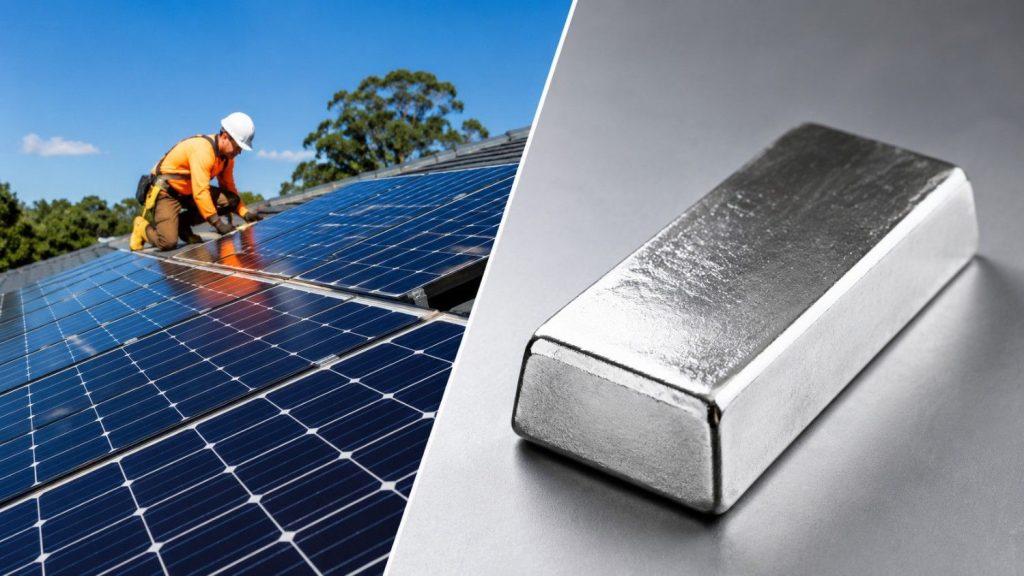
Solar photovoltaic (PV) manufacturing has become silver’s fastest-growing end market.
Each silicon solar cell uses silver paste to conduct electricity to the external circuit. Those are the metallic lines visible on a panel’s face. The amount per cell has fallen as manufacturers have optimized — a process the industry calls “thrifting.” But deployment has grown faster than thrifting has saved.
In 2024, solar PV consumed approximately 232 million troy ounces — roughly 19% of total silver demand and 34% of all industrial silver consumption [Silver Institute, World Silver Survey 2025]. A decade ago, solar’s share was a fraction of that. Global capacity additions hit a record 593 gigawatts in 2024, up from roughly 75 GW in 2016 [IEA, Renewables 2024].
Solar demand for silver grew approximately 12-fold over the past decade. Even as thrifting continues, absolute demand keeps climbing. As a result, the pipeline of planned installations globally makes clear this is a permanent shift, not a cycle.
Next-generation heterojunction (HJT) cells require roughly two to three times more silver than the PERC cells they’re replacing. As HJT adoption grows, silver demand per gigawatt of installed capacity could rise before it falls.
How Much Silver Does an Electric Vehicle Actually Use?
The link between EVs and silver isn’t obvious. EV batteries run on lithium, cobalt, and nickel — not silver. But the battery is only one system in a modern vehicle.
Silver runs through the entire electrical architecture: relays, switches, fuses, membrane switches. A conventional combustion vehicle uses roughly 15 to 28 grams. A battery electric vehicle runs higher-voltage systems with more complex circuitry and charging management — and that’s before accounting for next-generation battery technology. It uses approximately 25 to 50 grams — roughly double [Silver Institute, World Silver Survey 2025].
Global EV deliveries reached 17.6 million units in 2024 and are forecast to hit 65 to 75 million by 2030 [BloombergNEF, Electric Vehicle Outlook 2025]. Total automotive silver demand — combustion and electric combined — reached approximately 72 million troy ounces in 2024. That number grows with every percentage point of EV penetration.
Furthermore, these aren’t separate demand stories. Solar farms need grid upgrades. Grid upgrades need silver. EVs charge on that grid. Transportation electrification and energy generation each accelerate the other.
How Does Silver Industrial Demand Move Price?
Silver industrial demand moves price — though not always the way a standard supply/demand model would suggest.
Industrial silver doesn’t come back. It enters a solar cell, an EV relay, a semiconductor wafer. Most isn’t economically recoverable. Every ounce consumed by industry is permanently removed from available supply. Importantly, that creates a durable price floor that gold — which simply sits in vaults — doesn’t have.
The numbers bear this out. Mine production reached roughly 844 million ounces in 2024. Total demand reached approximately 1,219 million ounces. The resulting shortfall of approximately 195 million troy ounces marked the fourth consecutive annual deficit [Silver Institute, World Silver Survey 2025]. The gap is being covered by above-ground stockpiles. Crucially, those stockpiles are finite.
Year after year of demand outpacing supply means the market is drawing down inventory. That’s among the least-discussed dynamics in precious metals — and one of the most consequential.
What Happens When Both Demand Engines Run at Once?
When manufacturing is strong and monetary conditions favor precious metals, silver tends to outperform gold — sometimes sharply. The gold/silver ratio compresses. Silver closes the gap fast.
The reverse is also true. When industrial demand softens — as in the 2022 manufacturing slowdown — silver can lag gold even when monetary conditions are favorable. The industrial engine braking against an accelerating monetary engine creates a drag that pure gold exposure doesn’t face.
That’s not a flaw. It’s the nature of a metal with two large, partially independent demand drivers. The volatility cuts both ways — and the upside, when both engines run together, tends to be significant.
Stay On Top of Gold & Silver Prices
Get important market alerts sent straight to your inbox.
People Also Ask
Is silver a good investment because of industrial demand?
Silver industrial demand gives silver a floor that gold doesn’t have. Over 56% of annual silver consumption is tied to manufacturing and energy infrastructure — not investor sentiment. That doesn’t guarantee appreciation, but it means most demand exists regardless of whether financial markets are bullish or bearish on precious metals.
What percentage of silver is used in solar panels?
Approximately 19% of total annual silver demand — roughly 232 million troy ounces in 2024 — goes into solar PV manufacturing. That makes it the fastest-growing industrial end-use and the second-largest category, accounting for about 34% of all industrial silver consumption. The share has grown significantly over the past decade as solar capacity additions have accelerated globally.
Will silver run out due to industrial demand?
Not run out — but the market is running a persistent deficit. The Silver Institute documented a supply shortfall of approximately 195 million troy ounces in 2024, the fourth consecutive year. That gap is being covered by above-ground stockpiles, which are finite. The timeline depends on demand growth and new mining supply.
How much silver is in an electric vehicle?
A battery electric vehicle uses approximately 25 to 50 grams of silver — primarily in relays, switches, fuses, and charging management circuitry. That’s roughly double the 15 to 28 grams used in a conventional combustion vehicle.
Why can’t silver miners just produce more to meet demand?
Around 70% of silver is extracted as a byproduct of mining other metals — primarily copper, zinc, and lead. Production levels respond to the economics of those metals, not silver’s price. When silver demand rises, miners don’t open new silver mines; they expand copper or zinc operations when those margins support it. Ultimately, that supply ceiling is permanent, not temporary.
What Does This Mean for Silver’s Long-Term Price?
Nobody knows where silver’s price goes in the next twelve months. Confident forecasts are just guesses with better packaging. But the silver industrial demand picture is not a forecast — it’s a structure.
What the silver industrial demand picture tells you is more durable than any target. Industrial consumption is growing on technology adoption curves — not commodity cycles. Mining supply is capped by the economics of copper, zinc, and lead. The multi-year deficit is the output of that mismatch.
Still, silver’s monetary role — purchasing power protection, currency debasement, the gold/silver ratio — sits on top of that industrial base. When both engines run together, silver has historically outperformed gold. That’s not a prediction. It’s how the structure of this market works.
If that structure makes sense to you, the logical next step is owning physical silver. Not a paper claim. Not an ETF that lends it out. Metal you hold outright. You can start here.
SOURCES1. Silver Institute — World Silver Survey 20252. BloombergNEF — Electric Vehicle Outlook 20253. IEA — Renewables 2024
Disclaimer: This article is for informational and educational purposes only. It does not constitute investment advice. Please consult a qualified financial adviser before making any investment decisions.
You may also like:
Source link