🌆 Evening News Nuggets | Today’s top stories for gold and silver investors April 8th, 2026 | Brandon Sauerwein, Editor
The Iran ceasefire is already fraying, the Fed is publicly divided, and gold Federal Reserve policy uncertainty is at a cycle peak. Here’s what today’s news means for your money.
Why Is Iran Saying the U.S. Already Violated the Ceasefire?
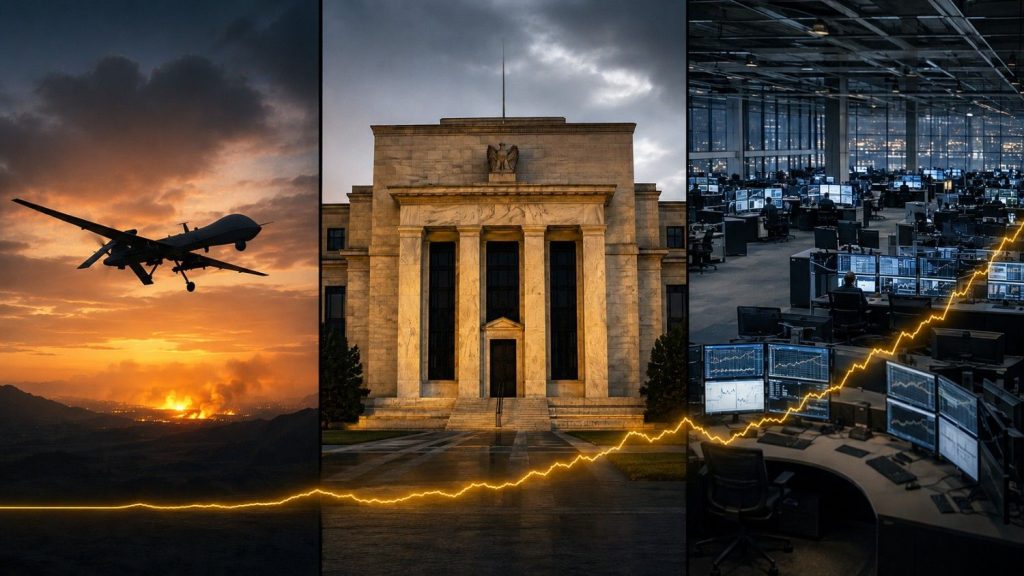
The ceasefire declared Tuesday night is already in trouble. Iran’s parliamentary speaker Mohammad Bagher Ghalibaf accused the U.S. of violating three parts of the agreement within hours of it taking effect. The violations: Israel’s continued strikes on Lebanon, a drone entering Iranian airspace, and the denial of Iran’s right to enrich uranium [CNBC].
The two sides were not describing the same deal. Trump declared Iran had accepted the “COMPLETE, IMMEDIATE, and SAFE OPENING” of the Strait of Hormuz [NBC News]. Iranian Foreign Minister Abbas Araghchi said passage would only be possible “via coordination with Iran’s Armed Forces and with due consideration of technical limitations” [CNBC]. The Financial Times reported Iran and Oman planned to charge transit tolls — a condition the White House rejected outright, insisting the strait must open “without limitation, including tolls.”
Stay Ahead with Gold & Silver News The most important market insights, Fed updates, and global trends — everything investors need to make smarter, safer decisions.
What Did Iran’s Parliamentary Speaker Say?
“The deep historical distrust we hold toward the United States stems from its repeated violations of all forms of commitments — a pattern that has regrettably been repeated once again,” Ghalibaf said [CNBC]. He added that under these conditions, “a bilateral ceasefire or negotiations is unreasonable.”
Lebanon is still contested. Pakistan said the ceasefire covered it [Al Jazeera]. Israel and the U.S. said it didn’t. No official written text exists — Trump announced the deal via Truth Social — leaving each party free to assert its own version.
What Does the Ceasefire Mean for Oil Prices?
Oil fell more than 15% to approximately $95 a barrel on the announcement. The relief is real — but partial. Before the war began on February 28, the Strait of Hormuz handled roughly 20% of global oil supply [CNBC]. Shipping analysts say tanker traffic has not recovered beyond the trickle seen during most of the war. Prices may have fallen. The problem hasn’t been solved. The next two weeks will show whether this ceasefire is a foundation for a longer deal — or the latest deadline to expire without one.
What Do the Fed’s March Meeting Minutes Show?
The Federal Reserve released minutes from its March 17–18 meeting Wednesday. The key takeaway: a central bank that doesn’t know what to do next — and is saying so openly.
More officials are now willing to consider raising rates. The number of policymakers open to hikes increased from “several” in January to “some” in March — and in Fed terminology, “some” is greater than “several” [Associated Press]. Many officials still expect the next move to be a cut, but only if the labor market continues to soften.
Why Is the Fed Caught Between Cutting and Holding?
The Iran war created this bind. Rising oil prices pushed inflation higher — and then undercut consumer spending at the same time. Fed Chair Powell put it plainly at the March meeting: “The net of the oil shock will still be some downward pressure on spending and employment and upward pressure on inflation” [CNBC]. Inflation has run above the Fed’s 2% target for five consecutive years, and the benchmark federal funds rate has held at 3.5%–3.75% since December 2025 [Charles Schwab].
The ceasefire shifted the oil picture fast. U.S. crude fell more than 15% toward $95 a barrel. If that holds, the inflation case for keeping rates elevated weakens — and the argument for a cut gets room to breathe. The next FOMC meeting is April 28–29 [Quartz]. Before then, the March inflation report arrives Friday. Economists forecast a 0.9% monthly increase, pushing the annual rate to approximately 3.4% [Associated Press]. That number will likely matter more than anything in today’s minutes.
The Fed has held its benchmark rate at 3.5%–3.75% since December 2025. The current U.S. prime rate is 6.75% [Federal Reserve].
Investing in Physical Metals Made Easy

SOURCES1. CNBC — U.S. Has Violated Ceasefire Agreement, Iran Parliamentary Speaker Says2. CNBC — Fed Meeting March 2026: Powell Says Inflation Isn’t Coming Down as Much as ‘Hoped’3. NBC News — Live Updates: Iran War Ceasefire Begins4. Al Jazeera — U.S.-Iran Ceasefire Deal: What Are the Terms, and What’s Next?5. Associated Press — More Federal Reserve Officials See Possible Rate Hikes This Year, Minutes Show6. Charles Schwab — Fed Holds Rates Steady, Still Sees One Cut in 20267. Quartz — Fed Minutes Show Divide Over Iran War Inflation, Rate Cuts8. Federal Reserve — FOMC Meeting Calendars and Information9. World Gold Council — Gold Research and Historical Price Data
This article is for informational purposes only and does not constitute financial or investment advice. Always consult a qualified financial advisor before making investment decisions.
You May Also Like
Source link