Published: 05-20-2026, 11:50 am | Updated: 05-20-2026, 02:31 pm
Key Takeaways
Gold ETFs, futures, and tokenized products track the gold price — but they are paper claims, not gold. In a crisis, that distinction can matter enormously.Physical gold carries no counterparty risk. No custodian, fund, or institution stands between you and your asset.Professional vault storage eliminates the storage problem. You can own allocated physical gold with the same convenience as a brokerage account.
Gold is trading at approximately $4,500 per troy ounce as of May 20, 2026 [World Gold Council]. However, the debate about physical gold vs digital gold matters more than most investors realise — because not all of these products are the same thing. Both show up on a brokerage statement with a dollar value attached. But what you actually own — what you hold, what you control, what survives a real crisis — is a very different story. This isn’t a debate about returns. It’s a debate about what “safe haven” actually means.
What Counts as “Digital Gold”?
The term gets used loosely. Here, specifically, is what it covers.
Gold ETFs — funds like SPDR Gold Shares (GLD) or iShares Gold Trust (IAU) — hold physical gold in vaults on behalf of shareholders. However, you own shares in the fund, not the gold itself. You can’t take delivery of your pro-rata bar. When you sell, you receive dollars, not metal [World Gold Council].
Gold futures and options, meanwhile, are contracts on the price of gold. No metal changes hands in most cases. Instead, you own a legal claim that expires — useful for hedging or speculation, but nothing more.
Tokenized gold products like Paxos Gold (PAXG) and Tether Gold (XAUt) — the most traded examples — represent gold positions on a blockchain. In theory, each token equals one troy ounce in a vault. In practice, however, the infrastructure, regulation, and redemption mechanics vary considerably between providers. Moreover, in most cases, retail investors cannot easily redeem for metal.
Gold savings accounts from banks and fintech platforms, similarly, let you buy “fractional gold” in paper form. These are typically unallocated — meaning you hold a proportional claim against a pool, not a specific bar.
All of these are paper claims on gold. Their value is derived from gold. But they are not gold.
Your Gold Buying Guide Most investors overpay when they buy gold. Then overpay again when they sell. This guide shows you exactly what to own — and why.
What Physical Gold Actually Is
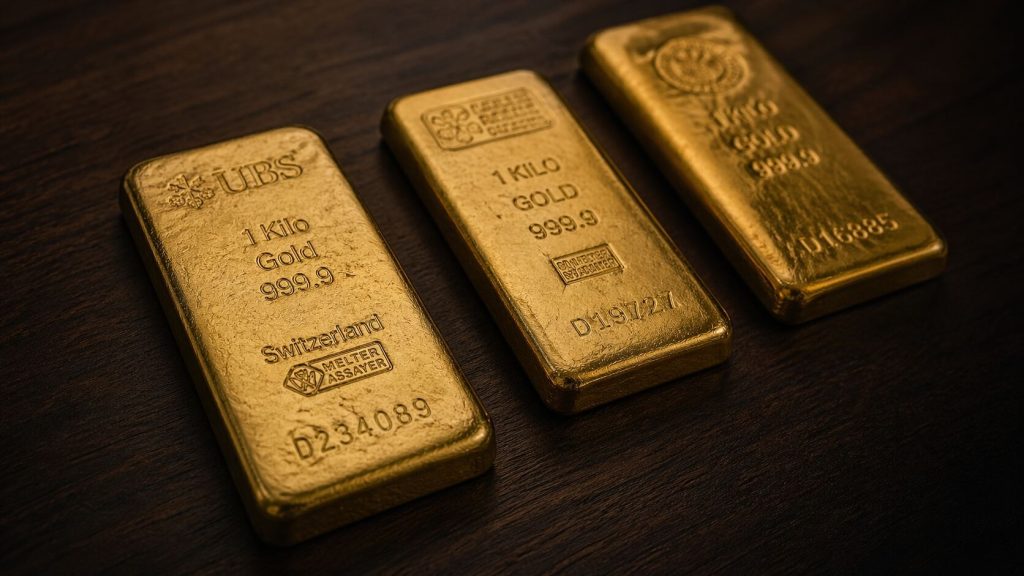
Physical gold — coins, bars, and rounds — is the metal itself.
A one-ounce American Gold Eagle, for example, isn’t a claim on anything. It doesn’t depend on a counterparty staying solvent, a blockchain functioning, or a custodian keeping its license. Specifically, it contains a guaranteed troy ounce of fine gold — alloyed with silver and copper for durability, with every grain of its gold content backed by the US Mint [US Mint]. Furthermore, gold in that form has been accepted as money for 5,000 years.
That distinction isn’t philosophical. It’s structural. And it matters most precisely when markets are under the most stress.
When Does the Physical Gold vs Digital Gold Difference Actually Matter?
In March 2020, COVID uncertainty hit markets hard. As a result, gold ETFs sold off alongside equities as investors scrambled for cash. GLD dropped roughly 13–14% from its February high. Physical gold premiums at dealers rose at the same time — in other words, the metal became harder to acquire even as its paper price fell [World Gold Council].
April 2025 saw the same dynamic, more severely. Paper gold sold off on margin calls and forced liquidations. Consequently, physical premiums widened to levels not seen in decades.
This is the paper vs. physical divergence. Paper gold responds to financial market signals — including forced selling by leveraged investors with no fundamental view on gold. Physical gold, by contrast, responds to actual monetary demand. As a result, the two can split apart exactly when you need your safe haven to hold.
There is also a structural issue with ETFs. When you hold one, you hold shares in a trust that relies on authorized participants, custodians, and the continuous functioning of the financial system. In a genuine crisis — a banking freeze, a settlement failure, a custody dispute — your recourse runs through those same institutions. Physical gold, however, has no counterparty. No one can default on a bar you possess.
What Does Digital Gold Actually Get Right?
Gold ETFs aren’t a bad product. For most investors, most of the time, they work fine.
They’re liquid and cheap to trade. Additionally, they sit easily inside brokerage accounts and retirement vehicles. GLD charges 0.40% annually [SPDR Gold Shares] — low friction for a tactical position. For a trader hedging equity risk over three to six months, therefore, an ETF is the right tool.
There are no storage decisions to make. There’s no insurance to arrange, and no logistics to manage.
Furthermore, ETFs held in tax-advantaged accounts offer benefits physical gold simply can’t match. That’s a genuine structural advantage for long-term retirement investors who prioritise tax efficiency over direct ownership.
In summary, the honest case for digital gold is this: it’s efficient, accessible, and purpose-built for financial market exposure.
Why Does Physical Gold Win Long-Term?
Physical gold’s advantages aren’t tactical. They’re structural. Specifically, four properties set it apart.
First, ownership is direct. No custodian sits between you and your wealth. In an era of rising financial surveillance and capital controls, that matters more than it used to.
Second, supply is genuinely finite. A government can print more dollars — it cannot, however, mine more gold on demand. Roughly 3,661 tonnes are produced globally each year, against an above-ground stock of approximately 216,000 tonnes [World Gold Council]. That ratio barely moves.
Third, gold exists outside the financial system entirely. Central banks hold over 36,000 tonnes collectively — not out of sentiment, but because gold carries no one else’s liability [IMF / World Gold Council]. It cannot be frozen, inflated away, or rehypothecated by someone else’s decision. When financial systems seize, therefore, gold doesn’t.
Fourth, it is portable, private, and sovereign. France repatriated its gold from US custody between mid-2025 and early 2026. As a result, central banks act on the same logic retail investors often forget: there is a meaningful difference between owning gold and owning a claim on it.
Do You Have to Choose Between Convenience and Real Ownership?
The most common objection to physical gold is straightforward: storage.
Fortunately, GoldSilver’s vault storage program removes that friction entirely. Investors own allocated physical gold — their own specific bars and coins — stored in highly secure, insured vaults with institutional-grade infrastructure.
InstaVault, GoldSilver’s flagship product, makes this process straightforward. You can buy and hold allocated physical gold and silver at low storage rates. In addition, you can take physical delivery whenever you choose. Your metal is segregated, insured, and audited — not pooled with other clients, and not held on a financial institution’s balance sheet.
As a result, the old trade-off no longer holds. Genuine physical ownership and operational convenience are no longer mutually exclusive.
Which Type of Gold Is Right for You?
The right answer depends on what you’re trying to do.
If you need a short-term hedge against equity risk, a gold ETF is efficient and cost-effective. It does the job cleanly.
If, however, you need long-term wealth protection against monetary debasement, physical metal is the only vehicle that fully delivers on that promise. US net interest payments crossed $1 trillion for the first time in FY2025 [Congressional Budget Office]. Central banks, meanwhile, are accumulating gold at a pace not seen in decades. Paper currencies continue to lose purchasing power. Consequently, a brokerage position doesn’t protect you from those forces — owning the metal does.
The practical framework is straightforward: use paper gold for fast, cheap, tax-advantaged market exposure. Use physical gold, on the other hand, for financial sovereignty — the kind that doesn’t depend on what’s happening inside the system.
Most serious investors hold both. The question is simply getting the proportions right.
Stay On Top of Gold & Silver Prices
Get important market alerts sent straight to your inbox.
People Also Ask
Is a gold ETF the same as owning physical gold?
No. A gold ETF gives you shares in a fund — a financial instrument, not the metal itself. You can’t take physical delivery. Moreover, your claim depends on the fund’s custodians and the financial system functioning normally. Physical gold, by contrast, carries no counterparty risk.
What is the difference between allocated and unallocated gold?
Allocated gold means specific, numbered bars or coins are held in your name. You own that exact metal — it doesn’t appear on the provider’s balance sheet. Unallocated gold, however, is a proportional claim against a pool the institution owns. As a result, it creates counterparty exposure if that institution runs into financial trouble.
Why do central banks hold physical gold instead of gold ETFs?
Because physical gold is the only reserve asset with no counterparty risk. Central banks collectively hold over 36,000 tonnes in bar form — a figure that has grown every year since 2010 [IMF / World Gold Council]. It cannot be frozen, defaulted on, or devalued by another government’s decisions. Gold ETFs, by contrast, offer none of these guarantees.
Can paper gold and physical gold prices diverge?
Yes — and they do during stress. In March 2020 and again in April 2025, paper gold sold off as leveraged investors raised cash. Physical premiums, however, rose sharply at the same time. Under normal conditions, therefore, the two track closely. Under stress, they can split in opposite directions.
What is the cheapest way to store physical gold securely?
Allocated vault storage through a specialist provider typically costs around 0.12–0.25% annually — significantly cheaper than most ETF expense ratios once storage, insurance, and audit are included. GoldSilver’s InstaVault is built specifically for this purpose: allocated physical metal in highly secure vaults, with the option to take delivery at any time.
So Which One Should You Actually Own?
Digital gold tracks the gold price. Physical gold is gold.
In a stable financial system, the difference between them is mostly academic. However, in the moments when a safe-haven asset is most needed — monetary stress, capital controls, institutional disruption — the difference can be everything.
Central banks don’t hold ETF shares. They hold bars. Every sovereign wealth manager who has studied the question has reached the same conclusion.
If you want to own gold the way the world’s most sophisticated institutions own it — allocated, vaulted, insured, and genuinely yours — GoldSilver’s vault storage program is designed for exactly that.
SOURCES1. World Gold Council — Gold Spot Price Data2. World Gold Council — Gold Demand Trends3. US Mint — American Gold Eagle Coin Specifications4. SPDR Gold Shares — GLD Fund Details & Expense Ratio5. International Monetary Fund — Gold as a Reserve Asset6. Congressional Budget Office — Federal Debt and Interest Costs
Disclaimer: This article is for informational and educational purposes only. It does not constitute investment advice. Please consult a qualified financial adviser before making any investment decisions.
You may also like:
Source link