Published: 07-20-2026, 02:20 pm | Updated: 07-20-2026, 02:44 pm
In four days, the world’s largest bank stops letting its retail clients trade paper gold. That decision was made quietly in Beijing last month. It is one of the most significant structural shifts in the global gold market this year — and almost nobody is covering what it actually means.
Industrial and Commercial Bank of China (ICBC) is the largest bank on earth by total assets. On June 24, 2026, ICBC announced it will cease offering individual china paper gold trading products linked to the Shanghai Gold Exchange (SGE) after the clearing session on July 24, 2026. ICBC is not alone. Postal Savings Bank of China, Ping An Bank, and China Guangfa Bank have all issued identical wind-down notices. China Construction Bank aligned with the same move weeks earlier. Retail clients have three choices before the deadline: close positions, liquidate holdings, or take physical delivery. After July 24, trading access simply turns off across mobile banking, online banking, and branch counters.
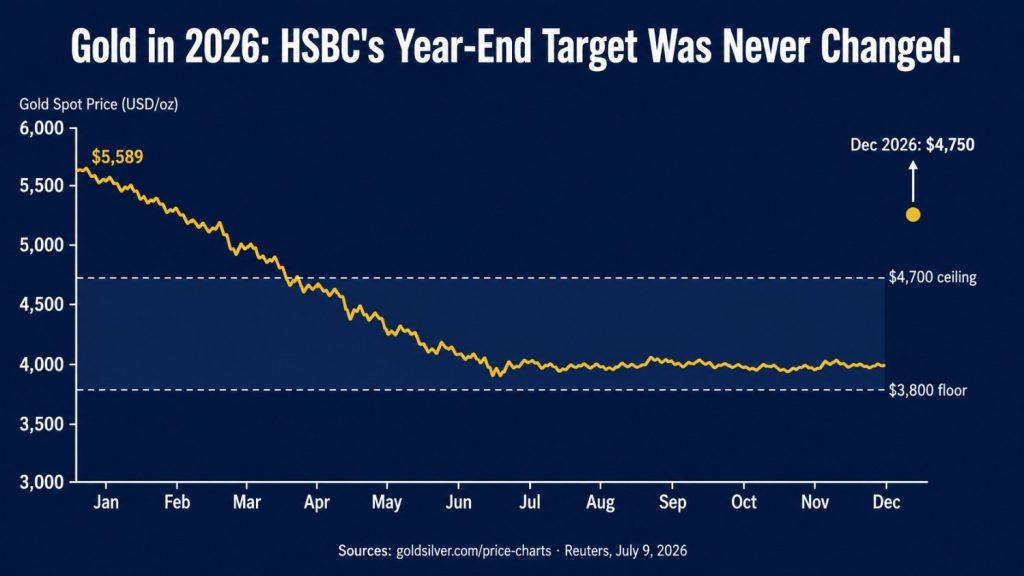
As of Monday, July 20, gold is trading near $4,010 an ounce, down roughly 28% from its January 28 all-time high of $5,589.38. This coordinated bank shutdown is the structural story behind that correction that most mainstream coverage has missed.
China’s largest banks are terminating retail leveraged gold trading on the Shanghai Gold Exchange. The deadline is July 24, 2026. Physical gold purchases, gold ETFs, and the SGE’s institutional operations are entirely unaffected. For long-term physical holders, this is a confirmation of the structural case — not a threat to it.
Why Did China’s Banks Exit Paper Gold Trading?
The official explanation is investor protection. Gold peaked near $5,589 in January 2026, then fell below $4,000 in June — a 30% decline in five months. That kind of swing turns leveraged retail positions into financial emergencies. Consequently, some banks responded by raising margin requirements to 140%, effectively making leverage economically unviable before shutting down the channel entirely.
However, the deeper explanation is institutional memory. In April 2020, Bank of China’s “Crude Oil Treasure” product was a structured vehicle offering retail clients exposure to West Texas Intermediate (WTI) futures. It collapsed when WTI oil went negative for the first time in history. Clients who had invested expecting a recovery instead found their account balances at zero or below. The bank ultimately absorbed roughly RMB 7 billion ($1 billion) in losses, according to Bloomberg reporting via the South China Morning Post. The incident reached the highest levels of government: then-Vice Premier Liu He issued a public statement calling on banks to strengthen controls over complex financial products.
Specifically, China’s banking regulators drew a direct lesson from that episode. When volatile commodity markets meet retail leverage, the financial system bears the cost of the downside — not the individual investor. The gold market’s 2026 correction handed regulators a second opportunity to apply that lesson. Notably, this time they acted before the losses arrived.
The Edge Every Investor Needs Smarter precious metals investing starts here. The Nuggets Newsletter brings you essential market insights, Fed updates, global trends, educational videos, and much more.
What Does This China Paper Gold Trading Shutdown Actually Affect?
This shutdown applies only to leveraged, bank-intermediated retail trading products linked to the Shanghai Gold Exchange. Specifically, it covers spot contracts such as Au99.99 and deferred delivery contracts such as Au (T+D). These are the margin products that let ordinary investors place leveraged bets on gold prices through their bank accounts.
However, it does not affect physical gold purchases, which remain entirely unrestricted in China. It does not affect China’s gold ETFs, which are listed on exchanges and available to retail investors without leverage. Furthermore, it does not affect the SGE’s institutional operations or physical delivery channels, which continue normally. It also does not affect Chinese central bank gold buying, which the People’s Bank of China (PBoC) has maintained for 20 consecutive months through June 2026, according to data released by China’s State Administration of Foreign Exchange.
In fact, China’s physical gold demand hit a record 207 tonnes in Q1 2026, according to the World Gold Council’s Gold Demand Trends Q1 2026 report. That figure counts bar and coin purchases alone. It arrived even as India paused on import duty concerns. The physical demand channel is entirely untouched by this regulatory action.
How Did Paper Speculation Affect Gold’s Price — and What Changes Without It?
Here is what most coverage of this story misses. Leveraged retail trading does not simply track the gold price. It amplifies it. In other words, millions of retail accounts in China were simultaneously long gold through margin products in January 2026. That collective positioning added upward pressure to a market already rising on central bank demand and geopolitical risk. When gold then fell 30%, moreover, those same leveraged positions became forced sellers — amplifying the decline on the way down.
Strip out that amplifier and the character of China’s gold market changes fundamentally. What remains is physical buyers: households purchasing gold bars and accumulation-plan units, institutions moving bullion, and the PBoC adding to its reserves. Those buyers do not sell because a margin call arrived. They do not liquidate because one week’s CPI data repriced Federal Reserve expectations. As a result, in a market dominated by physical demand rather than leveraged paper positions, price volatility compresses and the structural bid strengthens.
This is the same dynamic observed globally when paper market participants sold while sovereign buyers held through the Q2 2026 correction. Specifically, central banks purchased approximately 244 tonnes in Q1 2026 alone, according to World Gold Council data. They were buying into a historic quarterly price decline, not away from it. China’s regulatory action takes that same principle and applies it structurally at the retail level.
What Does This Mean for Investors Who Already Own Physical Gold?
For long-term holders of physical gold and silver, the July 24 deadline is not a threat. It is a confirmation. The instability of paper gold products is precisely the argument for owning the physical asset directly. A position in ICBC’s gold trading product carries ICBC’s counterparty risk, settlement risk, and — as of this month — regulatory risk. A gold bar in allocated storage carries none of those.
The mechanism, moreover, is not complicated. China is redirecting its retail gold market away from leveraged speculation and toward outright physical ownership. That shift removes the paper amplification that drove both the January 2026 price spike and the subsequent correction. Over time, a market priced by buyers who actually want to own the metal — not by traders betting on its direction — produces more durable pricing. The physical foundation strengthens accordingly.
That said, near-term catalysts remain important to watch. The FOMC meets on July 28–29, 2026, where markets currently price roughly an 87% probability of a rate hold, according to the CME Group’s FedWatch Tool. June PCE data — the Federal Reserve’s preferred inflation gauge — follows on July 30. Both events will move gold in the short term. The China structural shift, however, moves it in the direction that matters for the long term.
Stay On Top of Gold & Silver Prices
Get important market alerts sent straight to your inbox.
SOURCES1. Industrial and Commercial Bank of China (ICBC) — Suspension of individual SGE precious metals trading announced June 24, 2026, also via BigGo Finance2. South China Morning Post — Major Chinese banks suspend individual trading on Shanghai Gold Exchange amid volatility, June 25, 20263. NAI500 — End of Retail Bank Gold Leverage in China as ICBC Halts Trading, June 25, 20264. South China Morning Post — Bank of China’s US$1 billion hole from plunging oil, May 2, 20205. World Gold Council — Gold Demand Trends Q1 2026, April 29, 20266. GoldSilver — Live Gold Spot Price, July 20, 20267. CME Group — FedWatch Tool — July 2026 FOMC Rate Probabilities
Disclaimer: This article is for informational purposes only and does not constitute financial or investment advice. Always consult a qualified financial adviser before making investment decisions.
You May Also Like:
Source link